
Water Point Functionality Reporting Is Transforming Public Health in Malawi

In rural Malawi, the difference between a working pump and a broken one isn’t just inconvenience — it can be the difference between clean water and contaminated risk.
That’s why Fisherman’s Rest Community Projects (FRCP), through its Madzi Alipo programme, is helping to reshape how communities monitor water systems. By delivering consistent, evidence-based water point functionality reporting, local data is being used to support faster, smarter government decision-making.

Why Water Functionality Reporting Matters
Since 2021, the Madzi Alipo team has submitted quarterly reports to the Blantyre District Water Office (BDWO). These reports include real-time data collected using the Madzi Alipo Management System (MAMS) — a tool that tracks:
Water point status and usage
Flow volumes and demand
Repair history and performance
Bacterial and faecal contamination levels
This system is one of the few examples in Malawi where community-based water monitoring directly supports government WaSH planning.
TA Somba: What the Data Revealed
In 2022, Madzi Alipo additional monitoring was introduced into TA Somba, providing insight into growing public health risks related to water access.
🚨 Key findings:
47 Afridev pumps are under excessive pressure due to high demand
68 water points showed high levels of bacterial contamination
17 pumps tested positive for faecal coliforms, a key public health concern
These results were gathered through longitudinal water quality monitoring, covering both dry and wet seasons. The consistency of data allows the district to spot trends early, rather than reacting after outbreaks occur. Helping prevent illness and strengthen trust in rural water systems.

From Local Data to Government Action
This is the first time in Malawi that a rural WASH programme has offered functionality and water quality data directly to district water authorities—bridging the gap between community experience and government response.
The Madzi Alipo Management System (MAMS) makes it possible to integrate multiple indicators—functionality, demand, contamination—into one clear, usable format for decision-makers. The result is a smarter, faster, and more targeted government response.
The system can report on:
Contamination alerts
Pump performance
Water point demand
...Madzi Alipo is enabling more targeted infrastructure support where it's needed most.
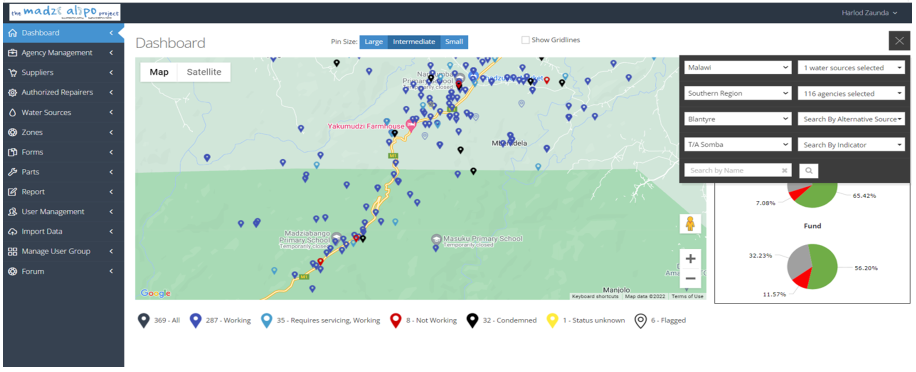
Looking Ahead: Sensor-Based Water Monitoring
We are looking towards smart devices that allow for real-time monitoring of pump performance. These sensor-based tools will allow for earlier alerts, faster repairs, and better prioritisation of high-risk water points.
Combined with ongoing WASH data dashboards, trained area mechanics, and digital monitoring systems, this approach offers a new blueprint for sustainable water system resilience.
And at the heart of it all is the belief that rural communities deserve not just water—but safe, consistent, and well-managed water infrastructure.
This step will improve:
Early warning for breakdowns
Faster repair response
More accurate WASH data dashboards
This system will also be offered to other agencies as a low-cost solution for tracking water point health and planning interventions.
Watch this space.
Explore how our area mechanic training supports sensor rollouts.
✅ Summary: Why The Madzi Alipo Model Matters
Safe water requires more than a pump—it needs information.
Community-generated data is driving change at the district level.
Real-time functionality reporting is helping identify and prevent health risks.

💧 Join Us in Strengthening Rural Water Systems
You can help expand this work across Malawi by supporting our efforts to train mechanics, deploy new monitoring tools, and respond quickly to water safety risks.
👉 Donate to support WaSH innovation in Malawi
👉 Subscribe to our newsletter for updates from the field
👉 Read how area mechanics are mapping water points across Dowa District


Comments